
What is Circuit Breaker?
Circuit Breaker is an automatic electrical switching device that stops current when a circuit draws too much electricity or develops a fault. The breaker protects conductors, equipment, and people from damage caused by overloads and short circuits. Specialized breakers also detect arc faults or ground faults and interrupt power within the circuit.
Quick Facts About Circuit Breaker
Category
Electrical protection device
Used for
Interrupting overloads and faults
Common confusion
A breaker is not the same as a fuse
Also called
Overcurrent circuit breaker, Electrical breaker
Often discussed with
Electrical Troubleshooting, Electrical Code Corrections
Key Takeaways About Circuit Breaker
- A breaker opens a circuit when current exceeds its rated limit or a detected fault creates danger.
- The ampere rating must match the circuit conductors, equipment, and expected electrical load.
- Resetting a breaker without finding the cause can leave an overload, short circuit, or damaged device active.
- AFCI and GFCI breakers add protection that standard overcurrent breakers do not provide.
Understanding Circuit Breaker

Circuit breaker is a resettable device in an electrical distribution system. It carries current from a panel to a circuit. It opens the circuit when current reaches an unsafe level. The device protects conductors from overheating. It also limits damage to connected equipment. A breaker doesn't prevent every electrical hazard. Correct wiring and proper installation remain necessary.
Related glossary terms: Overcurrent Protection, Breaker Panel, Electrical Panel.
Inside a standard breaker, a thermal element responds to sustained overload current. A magnetic mechanism reacts quickly to a high-current fault. An overload may occur when too many appliances share one circuit. A short circuit occurs when energized conductors make an unintended connection. This connection has very low resistance. Specialized breakers can also detect an arc fault or a ground fault. They then disconnect power.
How Circuit Breaker Works, Is Measured, or Is Used?
A breaker carries an ampere rating, commonly called its trip rating. The rating shows the current the breaker can carry safely. It applies under the breaker's listed conditions. The breaker opens during an overload. The rating must match the circuit design. This includes the wire gauge, equipment rating, and calculated load. A larger breaker isn't a safe replacement for a smaller breaker. The entire circuit must support the change.
Most breakers are mounted in an electrical panel. They connect to a line conductor. During normal operation, the breaker handle stays in the on position. Current flows through the protected circuit. During a trip, the internal contacts separate. This stops current flow. To restore power, first remove or disconnect the suspected load. Then move the handle fully off and back on. Repeated trips require fault testing, not repeated resets.
Why Circuit Breaker Matters?
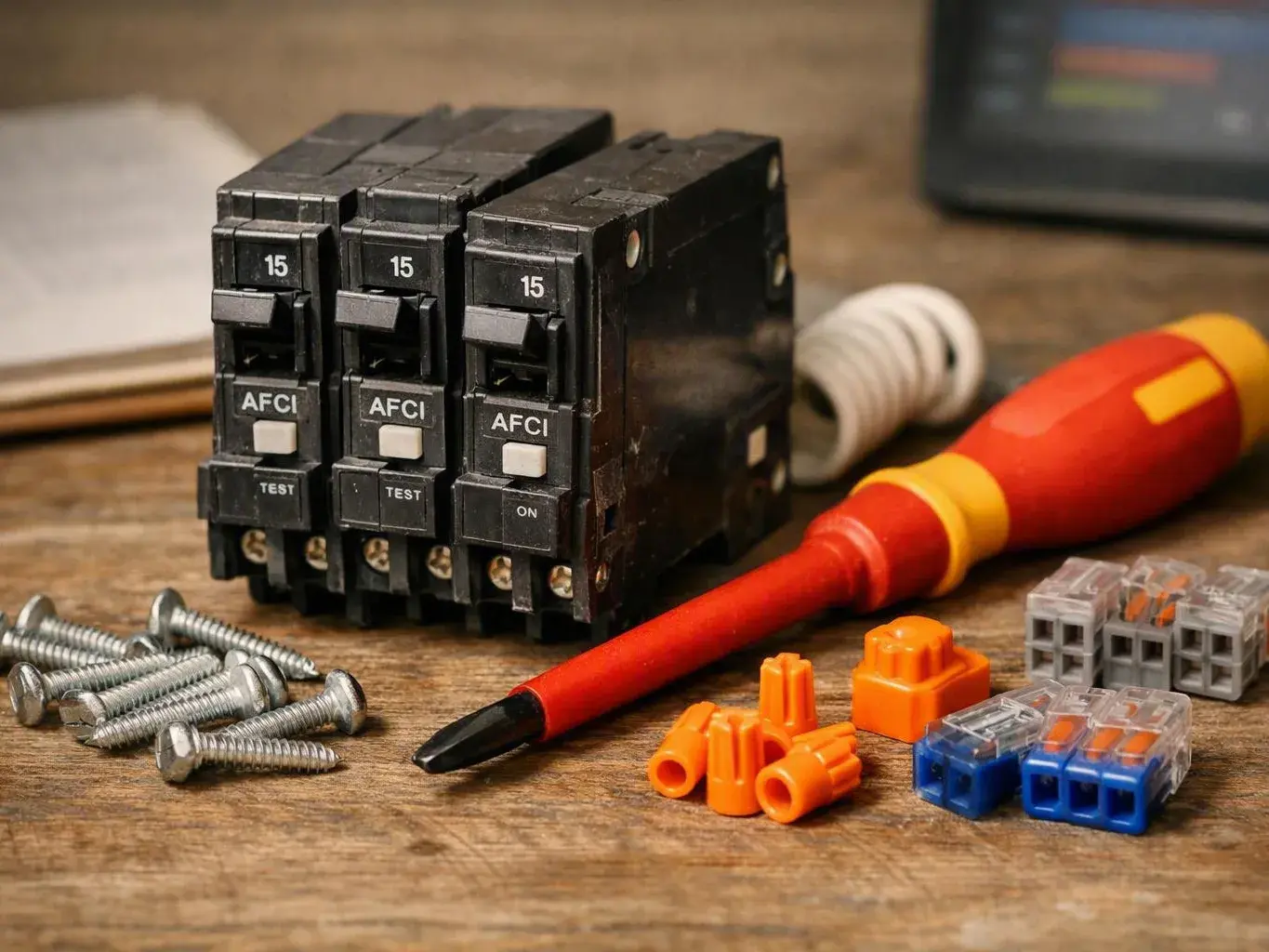
Correct breaker selection helps prevent overheated wiring, damaged insulation, and electrical fires. A breaker also makes circuit isolation possible during maintenance. A person can switch off power to a defined branch circuit. The protective result depends on the complete system. This includes the wire gauge, terminations, panel bus, and connected equipment. A breaker can't fix loose connections or damaged insulation. It also can't fix an incorrectly installed circuit.
Different breaker types address different risks. An AFCI breaker monitors for electrical arcing. Arcing can occur in damaged cords or wiring. A GFCI breaker compares current leaving and returning through the circuit. It trips when the difference suggests leakage to ground. A standard breaker mainly protects against overcurrent. Replacing a specialized breaker with a standard model can remove required protection.
When Circuit Breaker Matters Most?
Breaker performance deserves attention when a circuit trips often. It also matters when a breaker feels hot or smells burned. Discoloration near the panel can signal a problem. Flickering lights, buzzing sounds, and warm receptacles can also signal trouble. Unexplained power loss can point to a loose connection or failing device. Don't keep resetting a breaker that trips immediately. Turn off or unplug connected equipment when safe. Have the circuit tested before returning it to service.
Breaker selection becomes especially important during remodeling and appliance installation. It also matters during panel work and electrical load changes. A new electric range, heat pump, water heater, or electric vehicle charger may need a dedicated circuit. A load calculation may also be required. Local electrical rules may specify AFCI or GFCI protection in some locations. A qualified electrician can verify the breaker type and conductor size. They can check termination torque, panel compatibility, and available capacity.
How to Evaluate Circuit Breaker?
- Check that the breaker ampere rating matches the circuit conductors and the calculated electrical load.
- Look for repeated trips, heat, buzzing, burning odors, discoloration, or a loose-feeling handle.
- Confirm whether the circuit requires AFCI or GFCI protection under the applicable electrical code.
- Verify that the breaker is listed for the specific panelboard and installed in the correct position.
- Ask whether testing identified the fault before anyone resets or replaces the breaker.
Related Concepts Compared
Circuit Breaker vs. Fuse
A fuse opens a circuit by melting a metal element during an overcurrent event. A circuit breaker opens mechanically and can normally be reset after the fault is corrected.
Circuit Breaker vs. Ground Fault Circuit Interrupter
A GFCI detects an imbalance between outgoing and returning current, which can indicate leakage through a person or grounded surface. A standard circuit breaker mainly responds to overloads and short circuits.
Circuit Breaker vs. AFCI
An AFCI detects electrical arc signatures that may occur in damaged wiring or cords. A standard circuit breaker does not provide the same arc-fault detection.
Circuit Breaker vs. Electrical Panel
An electrical panel is the enclosure and distribution assembly that houses breakers, bus bars, and circuit connections. A circuit breaker is one protective device installed within or connected to that assembly.
Expert Note
A breaker that trips repeatedly is reporting a condition, not merely failing to do its job. The cause may be a bad appliance, overloaded circuit, loose termination, damaged cable, or defective breaker. Test the circuit before changing its rating or installing a replacement.
Common Mistakes or Myths About Circuit Breaker
- Installing a higher-ampere breaker to stop trips without confirming that the wiring supports the new rating.
- Resetting a breaker repeatedly after it trips immediately.
- Assuming every breaker provides ground-fault or arc-fault protection.
- Replacing a breaker with a model that is not listed for the panel.
- Ignoring heat, burning odors, buzzing, or discoloration around the panel.
Circuit Breaker in Practice: A Real-World Example
A 15-amp bedroom circuit trips whenever a portable heater and vacuum run together. The breaker is likely responding to an overload, not a random failure. Unplugging one appliance may restore operation, but a load review is needed if the circuit regularly supplies high-wattage equipment.
Sources & Further Reading on Circuit Breaker
Related Terms
Overcurrent Protection
Overcurrent Protection is a safety method that limits electrical current when a circuit carries more amperage…
Breaker Panel
Breaker Panel is the enclosure that receives electricity from a utility service and distributes it through…
Electrical Panel
Electrical Panel is the enclosure that receives electricity from a service utility and distributes it through…
Short Circuit
Short Circuit is an unintended connection between conductors that creates a low-resistance path for electric current…
Electrician Pittsburgh
Have Questions About Circuit Breaker?
Contact Electrician Pittsburgh for practical guidance on Circuit Breaker and related 24 hour electrician work in Pittsburgh.