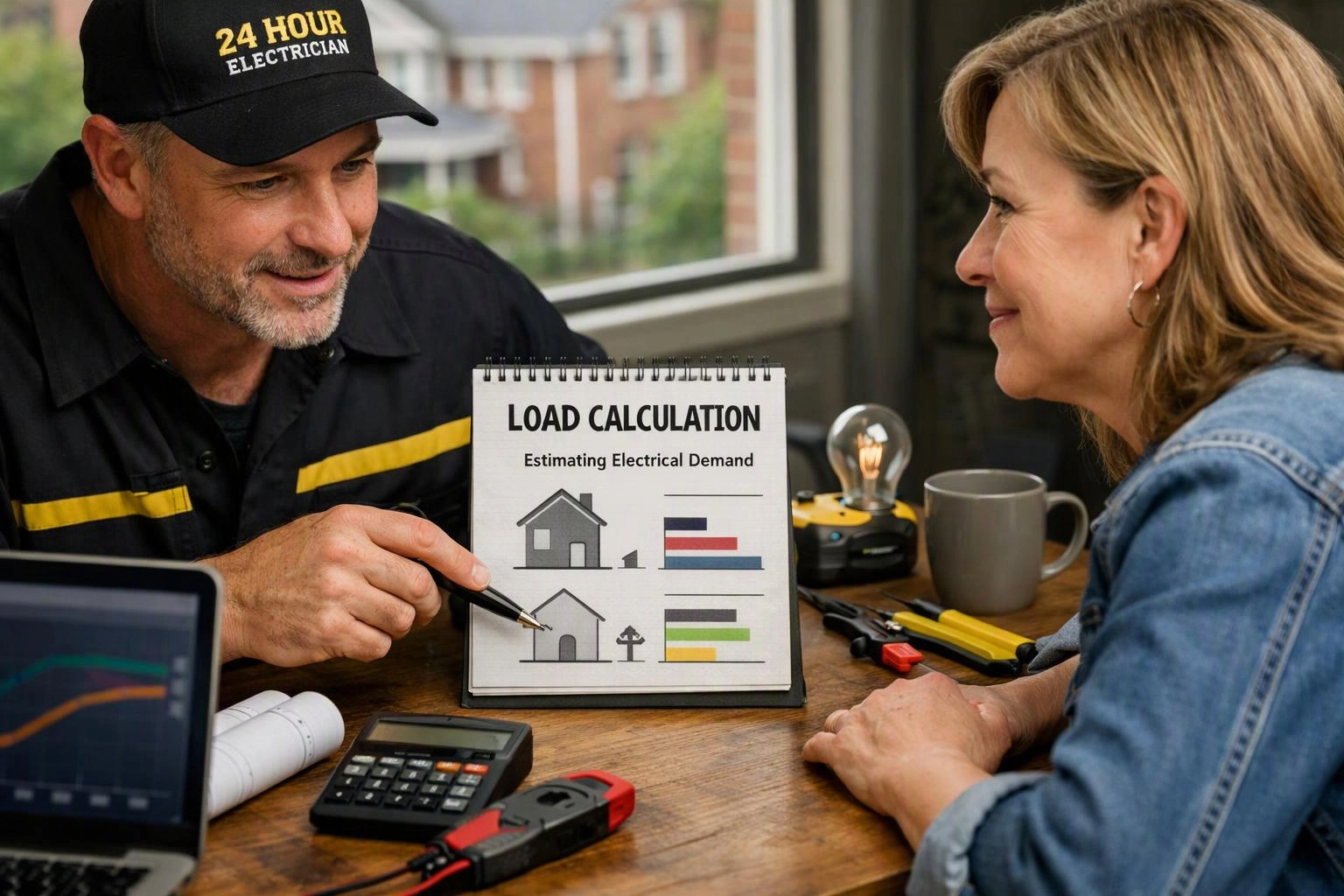
What is Load Calculation?
Load Calculation is a method for determining how much electrical power a building, panel, or circuit may need during normal and expected peak use. The process considers connected equipment, demand factors, voltage, amperage, motor loads, heating systems, and future equipment. Electricians use the result to size conductors, breakers, panels, and service equipment safely.
Quick Facts About Load Calculation
Category
Electrical design and safety calculation
Formula
Current equals power divided by voltage
Used for
Sizing services, panels, feeders, and circuits
Common confusion
Total connected watts are not always the calculated demand
Also called
Electrical Load Calculation, Service Load Calculation
Often discussed with
Electrical Code Corrections, Electrical Safety Inspections
Key Takeaways About Load Calculation
- A load calculation estimates maximum expected electrical demand, not simply the total wattage of every device.
- Electricians use demand factors because many appliances do not operate at full power simultaneously.
- The result helps size service equipment, panelboards, feeders, branch circuits, conductors, and overcurrent protection.
- Heating, cooling, motors, cooking equipment, electric vehicle chargers, and future loads can change the calculation.
- A proper calculation supports electrical safety, code compliance, and informed panel upgrade decisions.
Understanding Load Calculation

Load Calculation determines electrical demand. A building or circuit puts demand on its power system. The calculation considers equipment ratings, expected use, voltage, and how loads operate together. It shows whether an existing electrical service, panel, or circuit has enough capacity for present and planned equipment.
Related glossary terms: Electrical Panel, Circuit Breaker, Overcurrent Protection.
A nameplate rating shows an appliance's maximum power draw. But it doesn't always show the building's total demand. A home might have a range, air conditioner, water heater, lights, and receptacles. It might also have an electric vehicle charger. Demand factors account for equipment that runs only part of the time. They also account for equipment that doesn't run at full output together.
How Load Calculation Works, Is Measured, or Is Used?
An electrician begins by listing the connected loads, such as lighting, general-use receptacles, heating, cooling, motors, cooking equipment, and fixed appliances. The electrician records each rating in watts or volt-amperes. The electrician then applies the applicable demand rules. A basic relationship is current equals power divided by voltage. A 4,800-watt load at 240 volts draws 20 amperes. This result comes before other factors are considered.
The calculation may separate loads into categories. It may apply rules from the National Electrical Code, local requirements, and equipment instructions. The final result is compared with the rating of the service conductors, main disconnect, panelboard, feeder, and branch-circuit conductors. A whole-building calculation differs from a circuit calculation. The whole-building method considers combined demand from multiple systems.
Why Load Calculation Matters?

A correct load calculation prevents electrical equipment from being selected by guesswork. An undersized service or conductor can cause nuisance breaker trips, excess voltage drop, heat, and early equipment failure. An oversized installation may cost more than needed. Protective devices must still match the conductors and equipment they protect.
The result also supports decisions about a panel upgrade, new feeder, or added circuit. For example, adding a 50-amp electric vehicle charger may need more service capacity. The existing system may not provide that capacity. Reviewing demand before installation can identify needed changes. Wiring remains easier to reach, and permits can be planned correctly.
When Load Calculation Matters Most?
Load calculation matters during new construction, remodeling, service changes, and major equipment additions. It becomes especially important when a property adds electric heat, a heat pump, a hot tub, or a large range. It also matters for a standby generator, solar equipment, or an electric vehicle charger. Older homes may also need review. Their original service wasn't designed for modern electrical demand.
Use the calculation when an electrical permit or utility service change requires documented capacity. A useful review checks the service rating, main breaker, feeder size, voltage, equipment nameplates, and expected simultaneous demand. In Pittsburgh, seasonal heating loads and older housing stock can make these details significant. This matters during emergency troubleshooting or planned electrical work.
How to Evaluate Load Calculation?
- Check whether the calculation lists every major appliance, heating system, motor, charger, and planned future load.
- Confirm that voltage, wattage, amperage, and equipment nameplate data are recorded correctly.
- Compare the calculated demand with the service rating, main breaker, feeder conductors, and panel capacity.
- Look for demand factors that match the adopted electrical code and the equipment’s actual operating pattern.
- Ask whether local permit requirements or the electric utility require a specific calculation method or service review.
Related Concepts Compared
Load Calculation vs. Connected Load
Connected load is the total rating of equipment that could be connected to a system. Load calculation adjusts that total to estimate expected demand under normal operating conditions.
Load Calculation vs. Demand Load
Demand load is the amount of power expected at a particular time after applicable demand factors are applied. Load calculation is the broader process used to determine that value.
Load Calculation vs. Electrical Capacity
Electrical capacity describes how much current a service, panel, conductor, or circuit can safely carry. Load calculation estimates how much capacity the installation needs.
Load Calculation vs. Load Test
A load test measures system behavior while equipment operates under a selected condition. Load calculation predicts demand from equipment data and code-based assumptions before or without that test.
Expert Note
Do not size a service from the main breaker alone. A 200-amp main does not prove that every feeder, conductor, connection, or panel space can support a new large load. Review the calculation and the physical equipment together.
Common Mistakes or Myths About Load Calculation
- Adding every appliance wattage without applying applicable demand factors.
- Ignoring electric heating, motor starting loads, or equipment added during a later project.
- Assuming a larger breaker can solve an undersized conductor or service.
- Using an appliance’s maximum rating without checking its voltage and installation instructions.
- Treating panel space as proof that the electrical service has enough capacity.
Load Calculation in Practice: A Real-World Example
A Pittsburgh home has a 100-amp service and plans to add electric heat, a 50-amp vehicle charger, and a new range. The electrician lists the existing and proposed loads, applies the required demand factors, and compares the result with the service rating. The calculation may show that a service upgrade is needed before the new equipment is installed.
Related Terms
Electrical Panel
Electrical Panel is the enclosure that receives electricity from a service utility and distributes it through…
Circuit Breaker
Circuit Breaker is an automatic electrical switching device that stops current when a circuit draws too…
Overcurrent Protection
Overcurrent Protection is a safety method that limits electrical current when a circuit carries more amperage…
Panel Upgrade
Panel Upgrade is the replacement or modification of an electrical service panel to increase capacity, improve…
Electrician Pittsburgh
Have Questions About Load Calculation?
Contact Electrician Pittsburgh for practical guidance on Load Calculation and related 24 hour electrician work in Pittsburgh.