Skip to content
Glossary

What is Electrical Grounding?

Electrical Grounding is the intentional connection of an electrical system or equipment to earth through a conductive path. This path carries fault current away from people and equipment, helps stabilize voltage, and supports protective device operation. Grounding works with bonding, grounded conductors, and circuit breakers to reduce shock, fire, and equipment damage risks.

Quick Facts About Electrical Grounding

Category

Electrical safety and system protection

Used for

Fault-current paths and voltage stabilization

Common confusion

Grounding is not the same as bonding or neutral wiring

Relevant standard

NFPA 70, National Electrical Code

Also called

Grounding, Electrical Earthing

Often discussed with

Electrical Safety Inspections, Electrical Code Corrections

Key Takeaways About Electrical Grounding

  • Grounding directs dangerous fault current away from people and toward a safe electrical path.
  • Bonding connects metal parts so they remain at nearly the same electrical potential.
  • A ground wire does not replace a circuit breaker, fuse, or GFCI.
  • Grounding systems require correct connections, suitable conductors, and verified continuity.
  • Older homes may have grounded and ungrounded circuits in the same building.

Understanding Electrical Grounding

Electrician Pittsburgh — detail view — Understanding Electrical Grounding

Electrical grounding connects an electrical system or equipment to earth through a conductive path. The path may include a grounding electrode and conductor. It may also include an equipment grounding conductor and approved connections. Under normal conditions, little or no current flows on this path. During a fault, the path directs current away from people. It sends current toward the source so a protective device can open the circuit.

Related glossary terms: Ground Fault Circuit Interrupter, Neutral Wire, Overcurrent Protection.

Grounding doesn't mean electricity disappears into the soil. Soil often has too much resistance to clear a typical branch-circuit fault alone. The equipment grounding path must return fault current to the electrical source. This path must have low impedance. This difference explains why a ground rod alone can't replace an equipment grounding conductor. Grounding also helps limit voltage between the electrical system and earth. This applies during normal operation or a surge.

How Electrical Grounding Works, Is Measured, or Is Used?

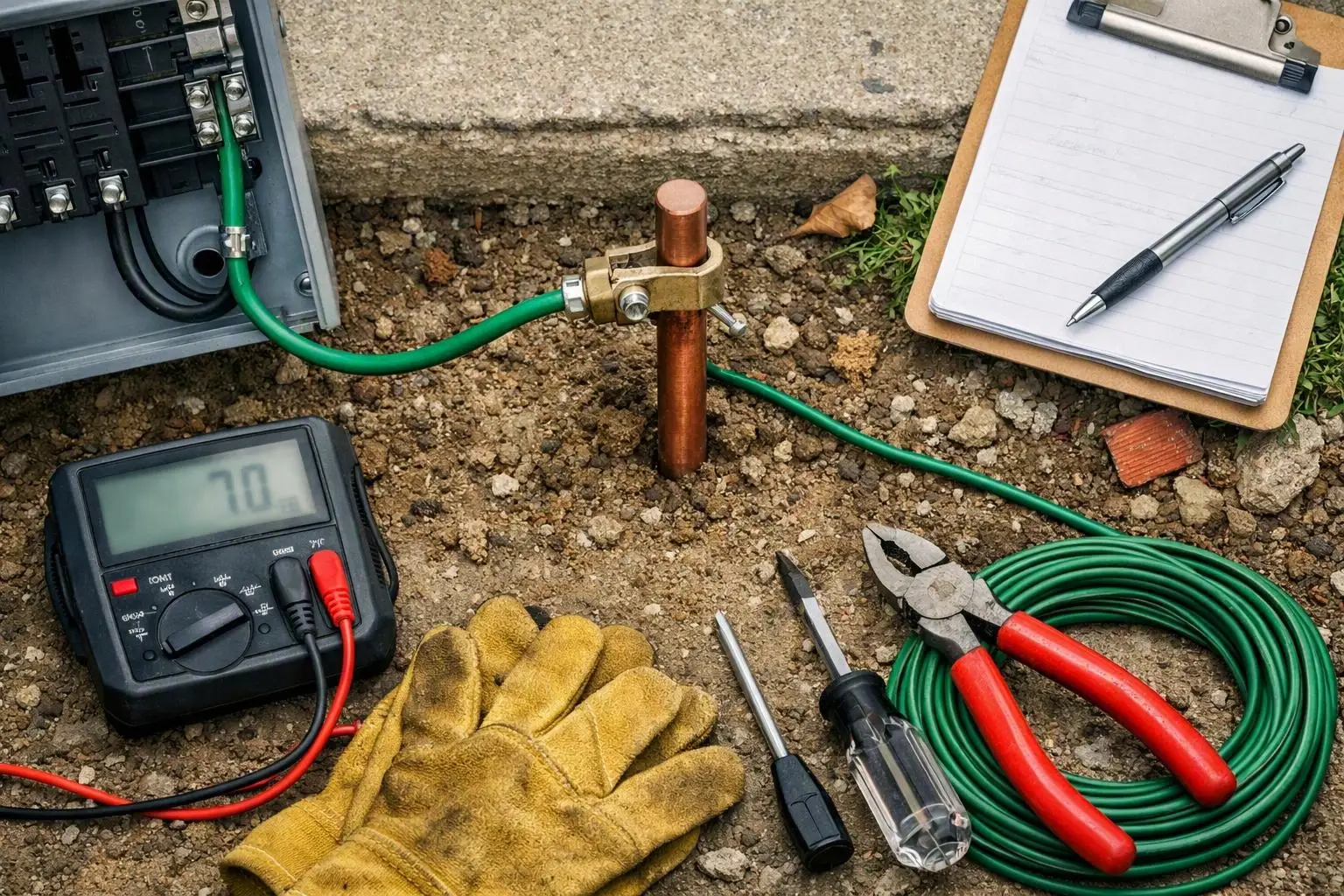
A typical system connects the service equipment to a grounding electrode system. This system may use metal water pipe, building steel, or concrete-encased electrodes. It may also use ground rods when the installation permits them. Separately, bonding connects enclosures, raceways, cable armor, and other conductive parts. The grounded conductor, often called the neutral, carries normal circuit current. The equipment grounding conductor normally carries current only during a fault.

An electrician evaluates grounding by tracing the full fault-current path. The path runs from the equipment back to the source. Common checks include continuity testing, connection inspection, and conductor identification. Electricians also take measurements with approved test instruments. A low-resistance path is generally preferred. However, one resistance number doesn't prove an installation is safe. The test method and system design affect the result. Bonding points, conductor size, and protective device ratings also affect it.

For example, a faulted metal appliance can place line voltage on its case. If the equipment grounding conductor and bonding connections work, fault current can rise quickly. This rise can trip a circuit breaker. A GFCI may disconnect power when it detects a small current difference. This difference occurs between current leaving and returning on the circuit. A GFCI protects against ground-fault shock. However, it doesn't create a grounding path for an ungrounded circuit.

Why Electrical Grounding Matters?

Electrician Pittsburgh — service highlight — Why Electrical Grounding Matters?

Proper grounding and bonding reduce the chance that exposed metal stays energized. This can happen after insulation fails. They also help breakers and fuses respond to faults. This response helps prevent heat from building in wiring. This protection matters near appliances, metal boxes, and service equipment. It also matters near outdoor circuits and wet areas. Grounding can support stable operation for sensitive equipment. It can also reduce damage from some electrical surges.

Missing, loose, or incorrectly connected grounding can cause serious warning signs. A receptacle may show an open-ground result. An appliance may give a mild shock. A metal raceway may lack electrical continuity. Reversing neutral and ground connections can place normal return current on metal parts. These problems may stay hidden until insulation fails or a surge occurs. They may also appear when someone touches equipment and a grounded surface.

When Electrical Grounding Matters Most?

Grounding needs close attention during electrical safety inspections, remodeling, panel replacement, and work on older properties. Homes built before modern grounding practices may contain two-slot receptacles or altered wiring. They may also have missing connections at replacement devices. A three-slot receptacle doesn't prove that a grounding path exists. Testing must confirm the circuit arrangement. It shouldn't rely on the receptacle shape.

Grounding also matters after water damage, lightning, equipment faults, generator installation, and service changes. Outdoor circuits, garages, kitchens, bathrooms, and metal equipment need careful review. Shock exposure can increase in damp locations. In Pittsburgh, older housing stock, basement wiring, and renovations can create mixed wiring conditions. These conditions deserve tracing before repairs or upgrades. Electrical work should follow the adopted code and equipment instructions for the property.

How to Evaluate Electrical Grounding?

  • Check whether every three-slot receptacle has a verified equipment grounding path.
  • Inspect bonding jumpers, panel connections, metal boxes, raceways, and grounding electrode conductors.
  • Ask whether neutral and ground connections are separated where the installation requires separation.
  • Look for open-ground results, damaged conductors, loose terminations, corrosion, or unexplained appliance shocks.
  • Confirm that testing follows the adopted electrical code and uses instruments rated for the system.

Related Concepts Compared

Electrical Grounding vs. Bonding

Bonding connects conductive metal parts so they share nearly the same voltage. Grounding connects the system or equipment to earth and supports a fault-current path.

Electrical Grounding vs. Neutral Wire

A neutral wire normally carries current back to the source during regular operation. An equipment grounding conductor normally carries current only when a fault occurs.

Electrical Grounding vs. Ground Fault Circuit Interrupter

A GFCI detects an imbalance between outgoing and returning current and disconnects power quickly. It provides shock protection but does not replace a grounding conductor.

Electrical Grounding vs. Ground Rod

A ground rod is one possible grounding electrode. It connects an electrical system to earth, but it does not by itself provide the low-impedance fault path needed for most branch-circuit breaker operation.

Expert Note

A ground rod test alone cannot confirm safe branch-circuit grounding. The full path must be checked from the receptacle or equipment enclosure through bonding and back to the source. Loose terminations and bootleg neutral connections can pass a simple plug-in test while creating serious shock hazards.

Common Mistakes or Myths About Electrical Grounding

  • Assuming a ground rod can replace an equipment grounding conductor.
  • Treating a three-slot receptacle as proof of a grounded circuit.
  • Connecting neutral and ground together at a downstream subpanel.
  • Using a water pipe or other metal part as an improvised grounding conductor.
  • Ignoring loose, corroded, or damaged grounding connections.

Electrical Grounding in Practice: A Real-World Example

A metal washing machine develops an internal insulation fault. With an intact equipment grounding conductor, fault current returns to the panel and trips the breaker. Without that path, the machine case may stay energized until a person provides the path to ground.

Sources & Further Reading on Electrical Grounding

Related Terms

Ground Fault Circuit Interrupter

Ground Fault Circuit Interrupter is a protective device that monitors current flowing through a circuit’s ungrounded…

Neutral Wire

Neutral Wire is the grounded conductor that normally carries current back to the electrical source after…

Overcurrent Protection

Overcurrent Protection is a safety method that limits electrical current when a circuit carries more amperage…

Residential Electrical Code

Residential Electrical Code is the set of safety rules that governs electrical wiring, equipment, circuits, and…

Electrician Pittsburgh

Have Questions About Electrical Grounding?

Contact Electrician Pittsburgh for practical guidance on Electrical Grounding and related 24 hour electrician work in Pittsburgh.

+1 (412) 530-6737