
What Is Knob-and-Tube Wiring?
Knob-and-Tube Wiring is an older electrical wiring system that carries power through separate insulated conductors in a building. Porcelain knobs support the wires, and porcelain tubes protect them where they pass through framing. You may find this wiring in the walls, attic or basement of an older home.
Quick Facts About Knob-and-Tube Wiring
- Category
- Residential electrical wiring
- Used for
- Supplying power to household circuits
- Common confusion
- Visible porcelain parts can remain after wiring is disconnected
- Also called
- Knob and Tube, K&T wiring
- Often discussed with
- Knob-and-Tube Wiring Replacement, Whole-House Rewiring
Key Takeaways About Knob-and-Tube Wiring
- Its conductors typically run apart rather than inside a shared cable.
- Replacement can involve opening walls to reach wiring.
- Porcelain parts alone don't prove that wiring is active.
How Knob-and-Tube Wiring Works

Knob-and-Tube Wiring carries current along a hot wire to a light or outlet. A separate neutral wire provides the return path. The wires follow routes through the building and connect at points along the circuit. Related service: Knob-and-Tube Wiring Replacement.
Related glossary terms: Branch Circuit, Neutral Wire, Electrical Grounding.
Knobs hold the conductors away from wood framing. Tubes form a protective passage through framing. The wire covering also helps separate the conductor from nearby material.
Modern cable typically groups conductors inside an outer covering. Older knob-and-tube circuits generally don't include a grounding conductor. A grounding conductor gives fault current a path back to the electrical system.
A home can contain both older wiring and newer cable. A connection between them may be hidden in a wall or ceiling. Tracing the circuit helps show which outlets and lights it serves.
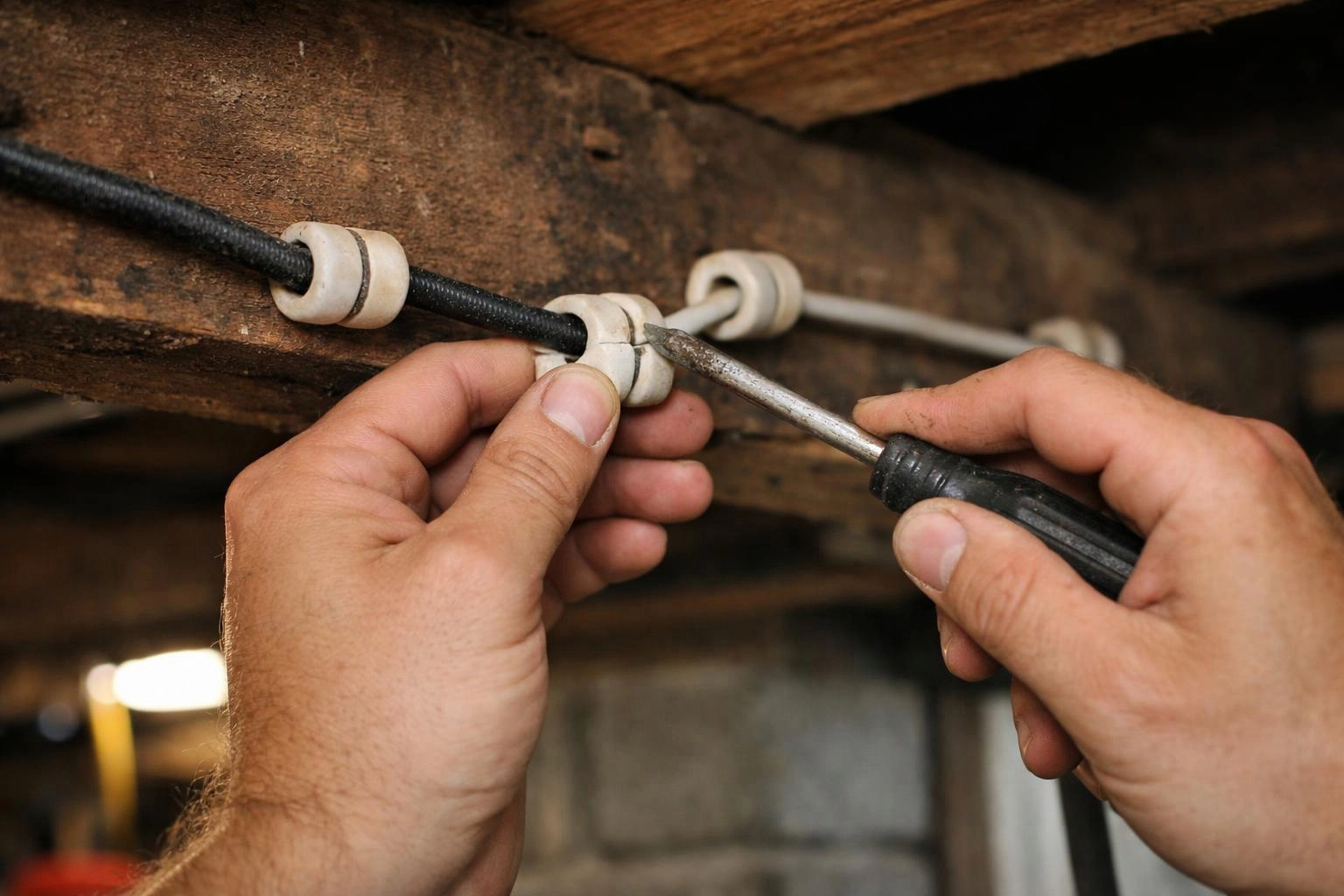
From the Electrician Pittsburgh team
When we plan knob-and-tube replacement, we trace the affected circuit and look at where it serves the home. We also check where older wiring meets newer wiring. That helps us plan the replacement route and identify places that may need access.
Knob-and-Tube Wiring in Practice: A Real-World Example
A Pittsburgh homeowner finds old wiring near an attic light and wants it replaced. The replacement plan follows the circuit to its outlets and accounts for access through the ceiling.
Related Terms
Branch Circuit
A branch circuit is an electrical path that carries power from a final circuit breaker or fuse to outlets and equipment.
Neutral Wire
A neutral wire is a circuit conductor that carries current back toward the electrical supply during normal operation.
Electrical Grounding
Electrical Grounding is a connection between an electrical system and the earth.
Junction Box
A junction box is an electrical enclosure that holds wire connections.
Electrician Pittsburgh
Have Questions About Knob-and-Tube Wiring?
Contact Electrician Pittsburgh for practical guidance on Knob-and-Tube Wiring and related 24 hour electrician work in Pittsburgh.